
Five readings off your bike settle most fit questions before we quote a part.
Speed count, freehub standard, brake mount, axle, then wheel size with the valve hole. Read these off the frame and you skip two rounds of back-and-forth email. Every part in our bicycle parts catalog is matched against exactly these five.
Read them in this order
The order matters. Speed count rules out half the catalogue on its own, and it's the one people guess at most.
-
Count the speeds at the back
Count the cogs on the rear cassette or freewheel. Not the clicks on the shifter, which can be off by one on older friction or index setups. Count the actual sprockets with a fingertip, small to large.
Tell us the speed count before anything else. An 11-speed chain is 5.5 mm wide. A 10-speed is 5.9. A 12-speed is 5.2. They are not the same part, and the wrong one will run quietly in the stand and then skip under load on the first climb.
- 12 speed chain, inner width5.2 mm
- 11 speed5.5 mm
- 10 speed5.9 mm
- 8 and 9 speed6.5 to 7.1 mm
-
Identify the freehub standard
A cassette slides onto a splined body on the rear hub. Shimano HG, Shimano HG 11-speed road, SRAM XDR and Shimano Microspline do not interchange. A Shimano HG compatible cassette 11-32 will not go on an XDR body, and an 11-speed road cassette needs the longer 11-speed road body unless the cassette comes with a 1.85 mm spacer.
Pull the cassette if you have the tool. If not, a photo of the hub with the wheel out, looking straight at the cassette lockring, tells us most of it. Older kids' and city bikes often have a thread-on freewheel instead, with no splined body at all. That changes the part entirely.
The measurement that matters is the length of the splined body. Roughly 34.9 mm for Shimano HG on 8 to 10 speed and most mountain hubs, about 36.75 mm on an 11-speed road body.
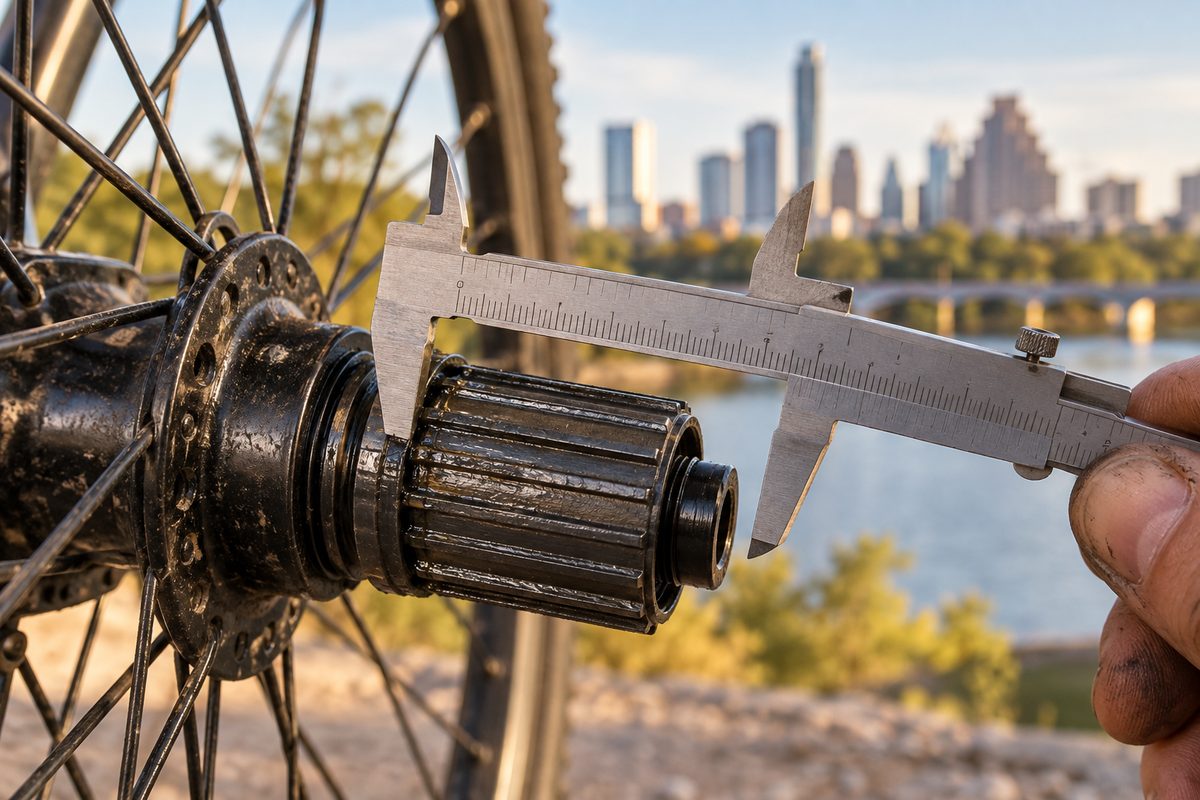
Splined body, cassette off. Length and spline count tell HG from road 11-speed. -
Read the brake mount
On disc bikes, look at where the caliper bolts to the frame and fork. Flat mount sits low and flush with two bolts coming up from underneath the chainstay. Post mount has two raised bosses with bolts pointing in toward the caliper. Flat-mount calipers ordered for a post-mount frame is the third most common wrong order we see, and adaptors don't always solve it cleanly.
Note the rotor size too, usually stamped on the rotor near the spokes: 140, 160 or 180 mm. Then whether it bolts on with six bolts or a Center Lock ring.
On rim brake road bikes, measure caliper reach: from the centre of the mounting bolt to the centre of the brake track. Standard reach is 39 to 49 mm; long reach is 47 to 57 mm. On kids' bikes, check whether there is a coaster brake in the rear hub. If backpedalling stops the bike, there is.
Hydraulic brakes need one more reading: the fluid. It's printed on the lever reservoir cap or the caliper. Mineral oil or DOT. We won't quote a hydraulic part without it.
-
Check the axle
Quick release has a lever on one side and a skewer through a hollow axle. Thru-axle is a thick bolt, usually 12 mm, threaded into the frame. Nutted axles have hex nuts on each side, common on kids' bikes and internal hub city bikes.
Then the spacing, frame dropout to dropout. 100 mm front on almost everything. Rear: 130 mm on road quick release, 135 mm on city and older mountain bikes, 142 mm on modern road and gravel thru-axle. A 12x142 thru-axle wheel will not go into a 130 mm quick-release frame, however hard you push.
-
Read the ISO wheel size and the valve hole
Look at the tyre sidewall for two numbers joined by a dash, like 28-622 or 47-406. The first is width in millimetres. The second is the ISO bead-seat diameter, and that's the one that decides fit. 622 is 700c. 584 is 650b. 406 is the common 20 in kids' size.
Most kids' bikes sold as 20 inch roll on ISO 406. A few run 451. They look identical from across a room and the tyres don't swap. When someone asks for a 20 inch kids bike wheel, ISO 406 is the usual answer, but we confirm from the sidewall every time.
Last: the valve. Presta is thin with a lock nut at the tip, in a 6.5 mm rim hole. Schrader is the car-tyre style, needing an 8.5 mm hole. A Schrader tube won't pass through a Presta-drilled rim. For deep road rims, measure the rim depth so we can match Presta inner tubes 700c with 48, 60 or 80 mm valves.
Common ISO bead-seat sizes ISO Sold as Usually on 622 700c, 28 in, 29er Road, gravel, many city bikes 584 650b, 27.5 in Gravel, some city and touring 507 24 in Older kids, small adults 451 20 in (less common) Some BMX-style and folding bikes 406 20 in Most kids' 20 in bikes, folding bikes 305 16 in Kids' 16 in bikes 203 12 in Balance and first pedal bikes

Three photos answer most of what we'd ask
Send a photo of the rear dropout. It answers half our questions. Axle type, brake mount, derailleur hanger shape and often the cassette are all in one frame if you stand on the drive side and shoot level with the hub.
- Rear dropout, drive side. Level with the hub, about 30 cm away, chain on the smallest cog. Hanger, axle end and derailleur in frame.
- Tyre sidewall, close. The ISO number in focus. Wipe the sidewall first; Austin dust hides the small print.
- The part that's worn or broken. In good light, with a coin or tape beside it for scale.
- Brake caliper or lever cap, for hydraulic brakes only, so we can read the fluid type.
Email photos to [email protected] with your name in the subject line, or mention them in the inquiry form and reply to our first email with them attached. Phone shots are fine. Please don't send video; a still at the right angle beats a minute of footage.
Questions we get about the checks
I can't find any numbers on the bike. Now what?
Send the photos anyway. Hangers in particular we match from the shape, not from a model name; model names change between years and the hanger often does too. If the photos still leave a gap, we say which reading is missing and why we need it.
Can you just tell me what fits from the make and model?
Sometimes, and we'll use it as a starting point. But bikes get modified. We've seen 9-speed shifters on frames sold as 10, and wheels swapped from another bike entirely. The readings off your actual bike win over any spec sheet.
Is this only for road bikes?
No. The same five readings work for road, city and commuter and kids' bikes. City bikes with internal gear hubs add one: the hub's own speed count, usually 3, 7 or 8, which you read off the shifter or the hub shell.
What if a part arrives and doesn't fit?
If it doesn't fit against the readings you sent, that's on us and the wrong-fit returns page covers it. If the readings were wrong, we'll still help you find the right part, but the return terms differ. That's why the checks come first.
Readings in hand? Send them over.
Our reply lists each part with the check that was run beside it, and an indicative price we hold for seven days. Target: one business day, Monday to Friday.